We've been harvesting! The peas are just ripening and are picked as they do- and eaten as they are :)
It is considered a treat here- I never manage to grow enough to satisfy the kids (or me for that matter).
Note for next time: plant at least two rows of squares...

"I know a bank whereon the wild thyme blows,
Where oxlips and the nodding violet grows,
Quite over-canopied with luscious woodbine,
With sweet musk-roses, and with eglantine:
There sleeps Titania some time of the night,
Lull’d in these flowers with dances and delight
-A Midsummer-Night’s Dream (2.1.260-5)
Monday, May 17, 2010


Monday, May 10, 2010
Mother's Day Garden
Mother's day in the garden is always fun! There is so much growing here in Central Virginia! The air is sweetly scented with honeysuckle and roses, and the birds are washing in the fountain!
My pomegranate has a bloom...

Just the one so far. My neighbour has spoken about cutting down the trees- especially after one of them broke off in the gales this weekend!
My daughter loves these chive blossoms- you can pick them and use them to make a pink chive vinegar!

My potatoes are getting huge- so I added a lot of mulch around them. After I watered them a LOT because the wind had dried out the ground so badly. I also transplanted one of the zucchinis I was growing into this bed.

The other one remains in the pot I planted them in:
My broccoli is beginning to flower too!

See the tiny little floret in the middle there? Just the first three I planted are blooming yet- but I suspect the others will soon too.
You can also see that my lettuce and spinach are doing great too...

I mulched around the broccoli because it'll help the roots to stay cooler, hopefully preventing it from bolting!
Something is munching on my spinach- but I am not sure what it is.
There are other triumphs occurring...

PEAS! Yes, large numbers of pods have been spotted on my pea vines!

These are a shelling variety- so I have to wait for the pods to fatten up before I get to pick them.
I also have baby tomatoes.

These are the sungold ones, so not much longer until I can actually eat them ;) And they are not the only ones...


 Look at all those new leaves!
My beans are growing like the proverbial weed. I nicely used a yardstick so you could see that ;)

As are their cousins the lima beans:

Those I did not measure for you!
Speaking of beans, take a look at these blackeyed peas...

They were part of my daughter's science experiment- she chose to grow blackeyed peas from the jar of them we had for cooking. She is quite proud of their progress- and I am amazed at how well they are doing.
I have a couple of swiss chard plants too. Here is one. Yes, I have picked a couple of leaves from the chard, spinach and lettuce. They make great salads!

And in the square next to this one, I transplated the other of my straightneck yellow squash- whose sibling can be seen in it's original pot below...
 The carrots are also doing well. The wind dried out the soil terrible though and it seems kind of rocky.

Finally the showpiece- corn with roses! Yes I measured that for you too...

My pomegranate has a bloom...

Just the one so far. My neighbour has spoken about cutting down the trees- especially after one of them broke off in the gales this weekend!
My daughter loves these chive blossoms- you can pick them and use them to make a pink chive vinegar!

My potatoes are getting huge- so I added a lot of mulch around them. After I watered them a LOT because the wind had dried out the ground so badly. I also transplanted one of the zucchinis I was growing into this bed.

The other one remains in the pot I planted them in:
 | |||||
| Black Beauty Zucchini |

See the tiny little floret in the middle there? Just the first three I planted are blooming yet- but I suspect the others will soon too.
You can also see that my lettuce and spinach are doing great too...

I mulched around the broccoli because it'll help the roots to stay cooler, hopefully preventing it from bolting!
Something is munching on my spinach- but I am not sure what it is.
There are other triumphs occurring...

PEAS! Yes, large numbers of pods have been spotted on my pea vines!

These are a shelling variety- so I have to wait for the pods to fatten up before I get to pick them.
I also have baby tomatoes.

These are the sungold ones, so not much longer until I can actually eat them ;) And they are not the only ones...
The other tomato is blooming!

And so is the other pepper!!

And in the best news of all- the decapitated pepper has sprung back:

My beans are growing like the proverbial weed. I nicely used a yardstick so you could see that ;)

As are their cousins the lima beans:

Those I did not measure for you!
Speaking of beans, take a look at these blackeyed peas...

They were part of my daughter's science experiment- she chose to grow blackeyed peas from the jar of them we had for cooking. She is quite proud of their progress- and I am amazed at how well they are doing.
I have a couple of swiss chard plants too. Here is one. Yes, I have picked a couple of leaves from the chard, spinach and lettuce. They make great salads!

And in the square next to this one, I transplated the other of my straightneck yellow squash- whose sibling can be seen in it's original pot below...


Finally the showpiece- corn with roses! Yes I measured that for you too...

Sunday, May 09, 2010
Guest Garden: Agecroft Hall

Agecroft Hall is a 15th century English manor house. It was transported from England to Virginia back in the early part of the 20th century, after it's original location in the heart of coal mining territory, meant that the house had become unstable.
It is a truly beautiful house, rescued but not rebuilt exactly to the original plans. The wealthy philanthropist who rescued it had willed it to become a museum after his wife no longer lived there. She and the people in control of the trust decided to make it a museum representing late renaissance and Tudor/Stuart life in England.
It is beautifully decorated with period pieces, but the gardens are of course, what interest us :)
Coming out of the courtyard of the house you can choose to go down hidden garden paths and into a sunken garden- designed to be like that at Hampton Court Palace in London.

It leads out to more secluded pathways, and you might find yourself at an outdoor banquetting hall- the docent told me that people would eat their desserts there after a banquet in the house. Below the hall is a still-room- where herbal preparations were made by the ladies of the house.
 |
| Banquetting Hall |

Coming out of the banquetting hall, you might sneak through another opening in the hedge, and find yourself overlooking extensive formal gardens.

Pass through a wrought iron gate...

The first is a herb garden- outfitted with all the culinary and medicinal herbs of the time- plus a few bee skeps!


Up the steps and you arrive in the Tradescantia garden.

Here are representatives of the numerous flora discovered by John Tradescant the elder and his son John Tradescant the Younger. In fact- they have the spiderwort you can see in my garden!

Up a second series of steps and you arrive in a knot garden. Knot gardens were very fashionable in Tudor times- tiny hedges of herbs were clipped into intricate patterns. It is NOT easy to do- we tried it once :) Establishing the plants into an even hedge would be the most difficult part- since typically one or two plants will die on you!


If you walk back through the formal gardens and out, you'll come to the rolling hills again, and be beneath that banquet hall.

A magnificent magnolia dominates the hillside- the air was redolent with that sweet scent.

Further up the hill and you meet the maze! It's a grass maze- nothing spectacular- but mazes were hugely popluar back then too. I wonder if they did that because of Hampton Court too- because if so, they got it wrong! Hampton Court had HUGE 6 foot tall hedges. I heard they got rid of it though!


If you go off of the terrace on the back of the house, you find a rose walk- where modern roses bloom effusively and scent the air.
 |
| Terrace |

There are more plants I did not get to photograph- people were all over the place! I managed to get the highlights though!

Next door, is another English transplant- the Virginia House, which was once a priory.

It has some nice gardens too- my everlasting memory from there is treading the paths to the smell of mint- a closer look revealed corsican mint between the pavers on that path! I can only show you outside though, because it was closed!


If you get to visit Richmond, Virginia, then take a look at these two magnificent homes!
Guest Garden: Bacon's Castle
Bacon's Castle is a Jacobean house situated in Surry, Virginia. The tour guides tell me it is the oldest High Jacobean brick house in America - I can assure you it is definitely a beautiful one!

The original structure is the one with the peaked roof on the left- the other two were built a couple of centuries later. Yes, here in America is a house whose history is measured in centuries rather than decades!
Isn't it pretty?
The gardens are legendary. The original owner (a wealthy English settler) imported English loam just so he could grow the things he was used to... and when the house finally came into the hands of Preservation Virginia (otherwise known as the Association for the Preservation of Virginia Antiquities) the gardens were long gone. Lucky for them, a previous owner had drawn a plan and they finally found them...
Nowdays, they are taken care of by volunteers- so of the six original beds, two are farmed and four remain as lawns.

You can see here two of the lawns- and in the distance, two of the farmed beds.
The beds surrounding the area are still cultivated... espaliered trees, cold frames... (the white fence thing on the right is an espaliered tree).

Herbs and veggies and medicinal plants...

The corn poppy (Papaver rhoeas) was a frequently used medicinal herb- it contains a much smaller amount of the alkaloids found in the opium poppy (Papaver somniferum) and can be used in much the same way- as a pain killer, sleep aid etc...

It's not the only herb either. Sage and the other culinary herbs were well represented- after all, it was a kitchen garden.

This is a South facing wall. It blocks the winter winds from the North, and is heated by the sun. That means that plants get an earlier start and it has a micro-climate that will often allow for tropicals to grow in otherwise inhospitable regions. Probably not here in Virginia though :) You'll be able to up your zone a notch or two- which in the case of England (whence this idea came) puts you into tropical territory. Here in Virginia, it allows you to garden year round ;) It is a fine example of a traditional English garden in fact- especially since it was most likely designed by the original (English) owner. Note the strategic placement of the cold frame. I'd bet that cool season crops can grow all winter long here- we are almost at sea level, which tends to extend the season ANYWAY (according to the wonderful Duke of Gloucester Street gardener in Williamsburg).

In fact, the leeks have been pulled from here, while other, warm season, crops are grown. At the far end (top right) are raspberry canes. This is quite a long way from the warm southern wall and so they are just about the same development as my own canes- which have their own micro-climate because they are at the top of a hill :)

I spotted some familiar faces- this fig had grown into a huge tree. With LOADS of figs! There was a strawberry that had so many fruits I was tempted to pick- and what I think is a pomegranate. I am not sure though- the day was windy with gusts going up to 40mph plus. It does not allow for close inspection- and my photos wanted to come out blurry- I was lucky to get what I did!
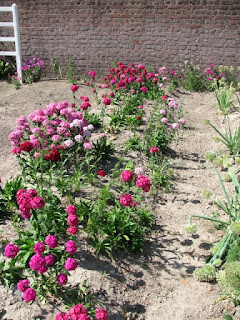
I would wait until the wind calmed a little before taking photos- but it means I sometimes forgot to read the labels :o. I forget what these are, but they are pretty! (And are next to onions from the look of it!).

It was so windy in fact- that this picture ended up being taken while the wind blew (it was gradually getting worse- and at this point did not calm down anymore). I was amazed it looked so good- the humble foxglove. I wonder if they used it medicinally!

The house is out in the middle of nowhere- it is after all, an old plantation. Yes, it had slaves at one point and was a tobacco farm. Nowdays it is in the middle of wheat fields- not quite amber waves of grain, but close! Stunning views all round!
If you ever find yourself in the region of Surry or Smithfield Virginia, then don't forget a visit to Bacon's Castle!
Why is it called that, you ask? Well Nathaniel Bacon rebelled against the then governor of Virginia, William Berkeley. There were a lot of raids by the native American Indians at the time, and there were a lot of policies that the people of Virginia disliked- so they complained to the governor. Who did not listen. He lived in the city of Williamsburg and did not have to suffer as much as the people. In protest, a young man called Nathaniel Bacon started a rebellion- which had an encampment here for a night. They pretty much trashed the place and decimated the owner (Arthur Allen's) wine cellar. Bacon died from some kind of infection a few days later, and is thought to have never actually visited there- but the moniker stuck!
This is a very brief retelling of the history, you'll have to read up on it for the best retelling!

The original structure is the one with the peaked roof on the left- the other two were built a couple of centuries later. Yes, here in America is a house whose history is measured in centuries rather than decades!
Isn't it pretty?
The gardens are legendary. The original owner (a wealthy English settler) imported English loam just so he could grow the things he was used to... and when the house finally came into the hands of Preservation Virginia (otherwise known as the Association for the Preservation of Virginia Antiquities) the gardens were long gone. Lucky for them, a previous owner had drawn a plan and they finally found them...
Nowdays, they are taken care of by volunteers- so of the six original beds, two are farmed and four remain as lawns.

You can see here two of the lawns- and in the distance, two of the farmed beds.
The beds surrounding the area are still cultivated... espaliered trees, cold frames... (the white fence thing on the right is an espaliered tree).

Herbs and veggies and medicinal plants...

The corn poppy (Papaver rhoeas) was a frequently used medicinal herb- it contains a much smaller amount of the alkaloids found in the opium poppy (Papaver somniferum) and can be used in much the same way- as a pain killer, sleep aid etc...

It's not the only herb either. Sage and the other culinary herbs were well represented- after all, it was a kitchen garden.

This is a South facing wall. It blocks the winter winds from the North, and is heated by the sun. That means that plants get an earlier start and it has a micro-climate that will often allow for tropicals to grow in otherwise inhospitable regions. Probably not here in Virginia though :) You'll be able to up your zone a notch or two- which in the case of England (whence this idea came) puts you into tropical territory. Here in Virginia, it allows you to garden year round ;) It is a fine example of a traditional English garden in fact- especially since it was most likely designed by the original (English) owner. Note the strategic placement of the cold frame. I'd bet that cool season crops can grow all winter long here- we are almost at sea level, which tends to extend the season ANYWAY (according to the wonderful Duke of Gloucester Street gardener in Williamsburg).

In fact, the leeks have been pulled from here, while other, warm season, crops are grown. At the far end (top right) are raspberry canes. This is quite a long way from the warm southern wall and so they are just about the same development as my own canes- which have their own micro-climate because they are at the top of a hill :)

I spotted some familiar faces- this fig had grown into a huge tree. With LOADS of figs! There was a strawberry that had so many fruits I was tempted to pick- and what I think is a pomegranate. I am not sure though- the day was windy with gusts going up to 40mph plus. It does not allow for close inspection- and my photos wanted to come out blurry- I was lucky to get what I did!

I would wait until the wind calmed a little before taking photos- but it means I sometimes forgot to read the labels :o. I forget what these are, but they are pretty! (And are next to onions from the look of it!).

It was so windy in fact- that this picture ended up being taken while the wind blew (it was gradually getting worse- and at this point did not calm down anymore). I was amazed it looked so good- the humble foxglove. I wonder if they used it medicinally!

The house is out in the middle of nowhere- it is after all, an old plantation. Yes, it had slaves at one point and was a tobacco farm. Nowdays it is in the middle of wheat fields- not quite amber waves of grain, but close! Stunning views all round!
If you ever find yourself in the region of Surry or Smithfield Virginia, then don't forget a visit to Bacon's Castle!
Why is it called that, you ask? Well Nathaniel Bacon rebelled against the then governor of Virginia, William Berkeley. There were a lot of raids by the native American Indians at the time, and there were a lot of policies that the people of Virginia disliked- so they complained to the governor. Who did not listen. He lived in the city of Williamsburg and did not have to suffer as much as the people. In protest, a young man called Nathaniel Bacon started a rebellion- which had an encampment here for a night. They pretty much trashed the place and decimated the owner (Arthur Allen's) wine cellar. Bacon died from some kind of infection a few days later, and is thought to have never actually visited there- but the moniker stuck!
This is a very brief retelling of the history, you'll have to read up on it for the best retelling!
Subscribe to:
Posts (Atom)