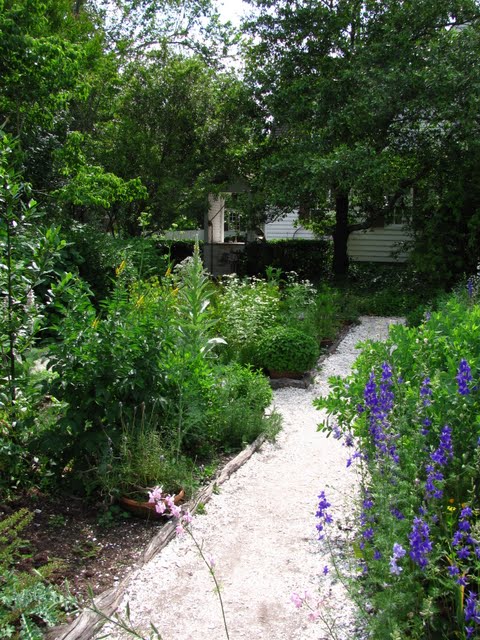
I meant to post this garden last year, when I visited it. Actually I visit the garden regularly, because Williamsburg is just not that far from here and this is one of my favourite gardens!
A stroll along Duke of Gloucester Street (known affectionately as "DoG Street"), Williamsburg will show you some of the most stunning gardens in Virginia. This is a graphics intensive post, so be patient!
This particular garden, sits outside a tiny white house, close to the entrance to Colonial Williamsburg. I have long been fascinated with it's beautiful shaped beds and brick pathways. The hedges surrounding the property are usually well groomed too, though not ornate in nature.
You can see the little house here. Most of the garden is given over to herbs, and a pleasant buzzing of bees can be heard once they bloom.
My favourite garden, however, is a little further down. This 'DoG Street Garden' also has a tiny garden centre, where seeds and plants, as well as colonial style decorations can be bought.
The costumed 'interpreter' for the garden, is a gentleman who is as knowledgeable about gardening as he is about the time period in question. He grows food year round (inspirationally) without much diffculty!
To the left, in this shot, is a living fence. A woven lattice of limbs! You can't see it though, because the peas hide it. In the centre, I believe we have some squash being grown vertically, while on the right are some melons growing on the ground. All the plants grown here are heirloom varieties thought to have been around at the time of the Colonial capital's heyday.
Onions, strawberries and peas. You can tell it is already getting a little warm for peas by the end of May (this is from May 31st) because they are yellowing.
As I said, they sell plants here. This picture appears to have a small pomegranate tree growing in a pot, with a couple of eggplants/aubergines beside it in other pots.
They extend the season with cold frames and hot beds. There is a lot of manure around, and the gardener uses it under the coldframe (buried deeply) to warm the bed up for early starts to beans, squash and peas while winter is still hanging around.
The cold frames are insulated with a layer of pine needles or straw.
Bell peppers have been transplanted outside at this point too. Here in Virginia, and early start with tomatoes and bell peppers will get us crops beginning in June.
I am always fascinated with the garden structures used for support in the colonial gardens. The rickety bamboo trellis here will probably house a vining green bean- they can get quite prolific in summer, and are often one of the first vegetables to produce, despite going into the ground from seed.
The whole garden is not all vegetables. Herbs and flowers grace it too- which means plenty of butterflies and hummingbirds.
I often get overwhelmed just
looking at the garden- there is SO MUCH to see! This is the path leading past the herbs and flowers...
It really is a riot of colour, and the buzzing of bees is very prevalent.
The pleurisy root/milkweed is there for the monarchs too.
The herb bed. There are all sorts of herbs there, and more interesting, is learning the herbs considered important by the Colonists.
Full, and beautiful herbs! Chamomile... mint... Feverfew... yarrow.... the list goes on.
This woven grapevine is wonderful isn't it?
You can see here that it was
very busy there... despite being rather early in the season. You can see the canopied area where they sell things straight ahead.
And a different view of the flowerbed. You can see Bruton Parish Church right opposite the garden too.
I am not sure what these are, but they are pretty!
Another fun garden structure there on the left... a woven fence. I am not sure what the circle is for, but I am guessing more squash, this looks like the traditional squash mounds. Then there is the metal thing holding the onions with their fabulous heads... I love those!
Here is a closeup of the fence!
I think this is a cardoon. So many of the veggies grown here are out of style I don't always remember what they are!
These rain barrels are the main source of water for the garden. They use old colonial style watering cans to water the garden, the ones with the gravity feed. You can also see some of the tip and pour style here too.
Three stages in the garden- ready to harvest, seedlings and the empty patch where either it has JUST been planted or is waiting to be planted.
Potatoes in the shady spot in the garden. Just as well really because it can get a little warm in the later part of the growing season.
Protection, colonial style. This is a thin, waxed canvas and NOT plastic, but it follows the same principals as the poly-tunnels.
Colonial style tools abound.
You often see them using one or another of the tools. I admit, I really liked the wheelbarrows!
Beans and onions.
Beets and parsnips. If you look to the top left you can see bell jars- another form of colonial protection for the crops.
The colours here were amazing. And not just the flowers either!
Here you can see the living fence I mentioned- interlaced branches of what looks to be willow :) I am not sure about that though- even though I remember when he was weaving them I actually asked him about them!
The two pomegranate trees. I have not done them justice in the photo because the blooms are quite spectacular. I love them- and this is where my one came from!
The garden centre itself is a lot of fun. Lots of plants, heirloom seeds... and at Christmas, decorations for you to make your own 'Williamsburg Decorations'.
And hats and bird houses and gravity feed watering cans... all sorts of colonial style fun!
I went round the garden again to see more!
I hope you enjoyed your tour around the Colonial Garden on DoG Street, Williamsburg!